
When the grid goes down, Olympus Electric wires homes and businesses across Tampa and Hillsborough County for reliable backup power, from the panel work behind the scenes to the generator itself, so your home is ready before the next storm hits, not scrambling after.


Tampa loses power more than most cities realize. Hurricane season runs June through November, and Tampa Electric has cut outage frequency by more than 23% and shortened outage duration by 32% since 2021, but the grid still goes down every storm season, sometimes for hours, sometimes for days. If you have lived here a while, you already know the drill: the lights flicker, then everything goes dark, and you are left wondering how long the fridge will hold.
So how do you know if you need a generator instead of just riding it out? Ask yourself a few things. Do you rely on medical equipment that needs steady power? Do you work from home and cannot afford a two day outage? Do you have a sump pump keeping your crawl space dry? If you answered yes to any of those, backup power stops being a comfort item and starts being a necessity.
We hear the same stories every storm season. A family in an older Sulphur Springs home loses power for three days after a summer storm and watches an entire freezer of food go bad. Someone else calls the morning after, asking how fast we can get a generator installed before the next system forms. Most of the time, it is not the first outage that gets people to call. It is the second one.
Not every home needs a whole house setup right away. If outages in your area are short and rare, a smaller unit covering the essentials might be enough for now. But if you have aging trees near the lines, live in a flood-prone spot, or just hate the uncertainty of storm season, that is usually a sign it is time to stop waiting and start planning.
Not sure where to start? See our full lineup of Tampa generator services further down this page, or call us directly.
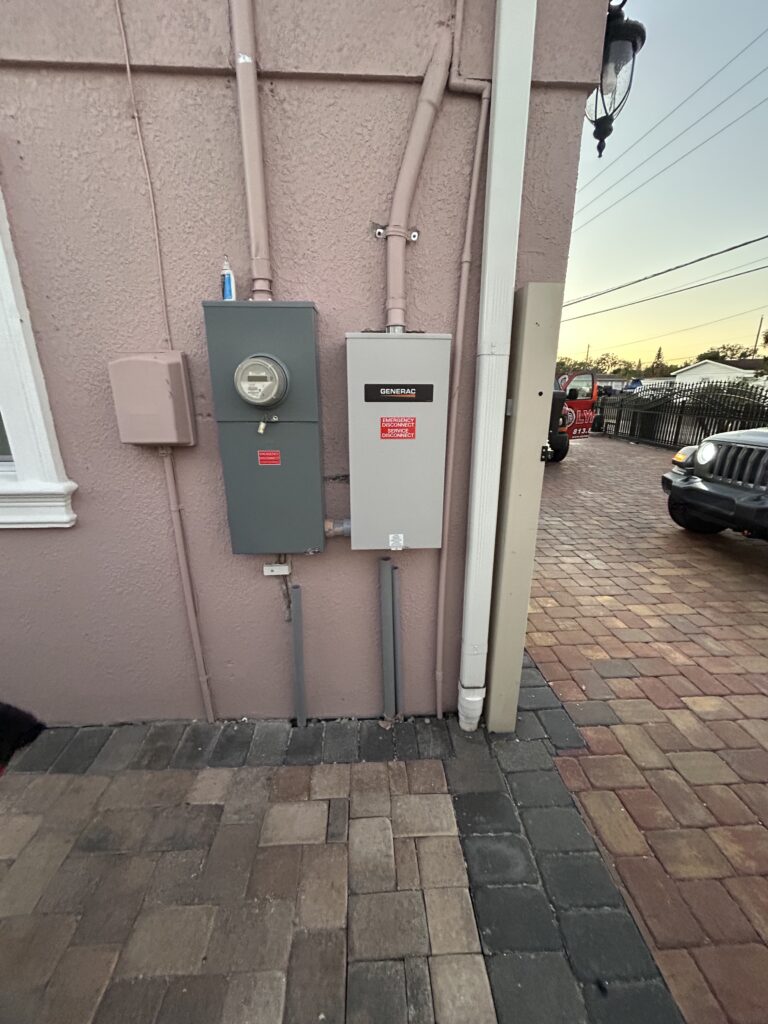
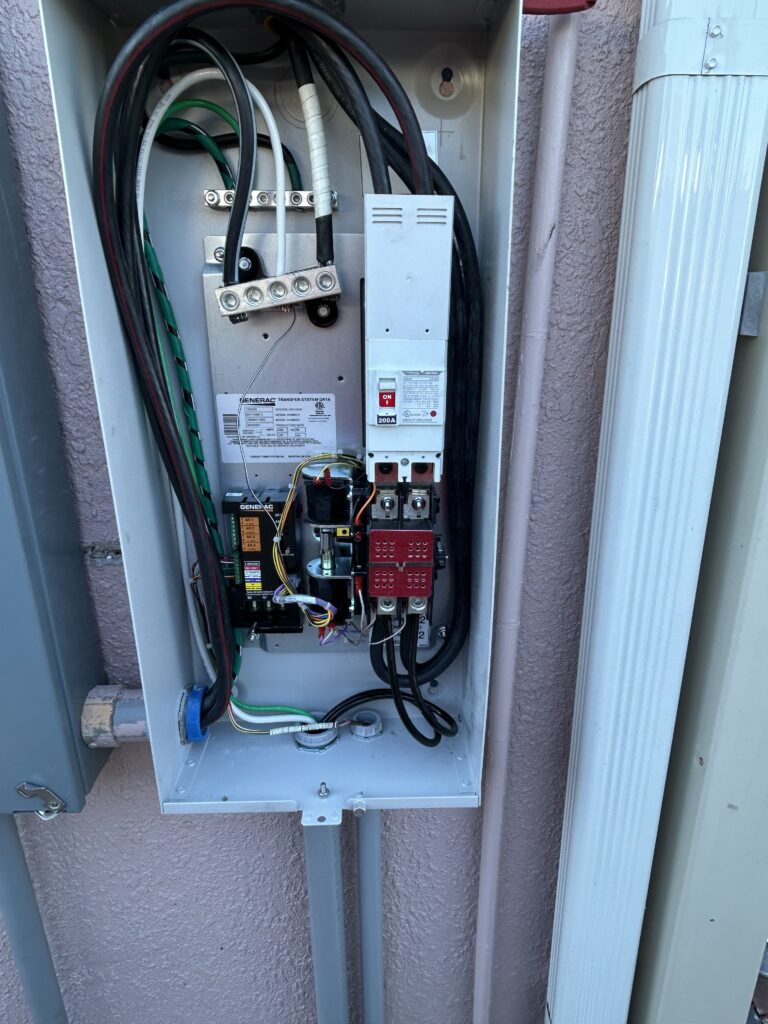
Here is something we run into constantly. A homeowner in Seminole Heights or Wellswood calls wanting a generator, and the first thing we find is a panel that cannot handle one. A lot of these houses went up in the 1950s and 60s, back when 60 amp or 100 amp electrical service was normal. Some still have the original fuse box. Nobody has touched it since.
That matters because a generator installation is not just about the generator itself. It is about how power moves from that generator into your house safely. That requires a transfer switch tied to a panel with enough room and the right condition to accept it. An old fuse box or an undersized breaker box often cannot take that connection without an upgrade first.
So before we talk generator size or placement, we look at the panel. Is it rated for the load? Are the breakers original? Is there aluminum wiring feeding into it, which shows up a lot in homes built during the copper shortages of that era? Each of these changes the plan. Homeowners are often surprised the panel is even part of the conversation.
An electrical safety inspection tells us exactly what we are working with, and it is the honest starting point. Sometimes the fix is a straightforward breaker box upgrade. Other times it is a full electrical subpanel installation to handle the transfer switch load separately from the main panel. If we find aluminum wiring in bad shape, aluminum wiring replacement might come up too, though not every home needs it.
Skip this step and you risk a generator that cannot legally or safely connect to your home the way it should. That is not a corner worth cutting.
See exactly what we check during electrical panel upgrades in Tampa.
So which one is right for your house? It depends on how much power you need, and how much you want to think about it during a storm.
A full standby system sits outside your home, wired straight into your electrical panel through an automatic transfer switch. Power goes out, the generator kicks on by itself within seconds, and your whole house, or the circuits you choose, keep running. No extension cords. No running outside in the rain to start anything. For homes near Riverside Heights and Wellswood with older panels, this often means a panel upgrade happens alongside the generator install, since the transfer switch needs a panel that can handle it safely.
An interlock kit is a smaller mechanical device installed on your breaker panel. It lets you safely connect a portable generator to your home’s wiring, but you still have to bring the generator out, fuel it up, and start it manually. It is a much lower cost entry point, and for folks who just want lights, the fridge, and a window unit running during a Florida summer outage, it can be plenty.
A third option worth knowing about is a whole home battery backup. It stores grid power and releases it automatically during an outage, with no fuel to manage and no exhaust to plan clearance around. It is a good fit for homeowners who want automatic backup without a fuel line, especially if solar is already part of the plan.
Here is what usually decides it for our customers:
We walk through your panel, your breaker box age, and your daily routine before we recommend an option. Most of the time, the answer is pretty clear once we see the setup in person. We just have to look.
| Option | Best For | How It Starts | Typical Cost Range |
|---|---|---|---|
| Full Standby System | Whole home coverage, frequent or multi-day outages, medical equipment | Automatic transfer switch, no manual action needed | 8,000 to 15,000 USD installed |
| Interlock Kit | Essential circuits only, occasional short outages, lower budget | Manual, homeowner connects a portable generator | Lower entry cost, portable generator priced separately |
| Whole Home Battery Backup | Fuel-free backup, quiet operation, pairing with solar | Automatic, draws from stored charge | Varies by battery capacity and panel needs |
Featured Services
Installation is where most jobs start, but generators need care after the first storm too. Here is the full range of what Olympus Electric handles.
Whole home standby systems, interlock-ready setups, or battery backup, sized to your panel and permitted the right way from day one.
A generator that will not start, will not transfer power, or trips on load is a liability during a storm, not a backup plan. We diagnose and repair standby and portable units so they work when the grid drops.
Older units lose efficiency and get harder to source parts for. We remove the old system, size a new one to your current electrical load, and reconnect it safely to your panel and transfer switch.
Tampa's heat and humidity are hard on batteries, filters, and wiring connections. Annual maintenance catches small issues before they become a dead generator the morning after a storm.
Automatic transfer switch systems that detect an outage and restore power in seconds, no extension cords and no manual startup required.
A fuel-free option that stores grid power and releases it during an outage. Quiet, no exhaust to manage, and a good fit alongside solar.
Generator installation in Tampa is not a one and done job you knock out in an afternoon. It is a process, and skipping steps is exactly how people end up with a generator that fails the first time a storm knocks out power. Here is how it goes, start to finish.
That inspection step trips people up the most. Homeowners want it running the same day they call, we get that. But the inspector has to see the grounding, the clearances, and the transfer switch wiring before anything gets closed up. Rush it, and you risk a failed inspection that costs you more time in the end, not less.
Placement matters too. Older homes near Riverside Heights and Tampa Heights often have tighter side yards, so clearance from windows, property lines, and fuel sources becomes a real planning issue, not just a preference. We have had jobs where the obvious spot for the unit turned out to be a code violation waiting to happen. So we plan the location first, before anything gets ordered or scheduled.
Once it is inspected and signed off, we walk you through startup, transfer testing, and what to watch for during the first real outage. That is the moment this whole process is built for.
We finish the job, clean up, and make sure everything is working correctly.
+1 (813) 851-4546
Testimonials
What they're saying about ourservices
Posted on GoogleTrustindex verifies that the original source of the review is Google. Jean is the best! After the hurricanes, he made me a priority and got my electricity up to code in time for power to come on. He is always on time and goes out of his way to go above and beyond! His prices are fair and he guarantees his work. I am so grateful he is my electrician. I will call no one else!Posted on GoogleTrustindex verifies that the original source of the review is Google. Jean and his team made amazing job and helped us with the remodel of our house. Fair price, super professional, great communication and made everything we wanted to be done very quick. Highly recommended!!Posted on GoogleTrustindex verifies that the original source of the review is Google. Jean was professional, polite, and efficient. He arrived on time, quickly diagnosed and fixed the issue, and explained everything clearly. Great service overall, and I would definitely recommend him.Posted on GoogleTrustindex verifies that the original source of the review is Google. I had a great experience with Olympus Service. From start to finish, the process was smooth, professional, and efficient. Jean was especially outstanding he took the time to explain everything clearly, made sure the work was done right, and went above and beyondPosted on GoogleTrustindex verifies that the original source of the review is Google. Best electrician out there, Jean was professional, reliable, and did an amazing job. Everything was done right, on time, and with great attention to detail. He was easy to work with and made the whole process smooth and stress-free. I highly recommend him to anyone looking for a great electricianPosted on GoogleTrustindex verifies that the original source of the review is Google. On time,prices reasonable i highly recommend great personalityPosted on GoogleTrustindex verifies that the original source of the review is Google. Jean went above and beyond to help us with our electrical issue after hurricane Milton. We will use Olympus again, highly recommend!Posted on GoogleTrustindex verifies that the original source of the review is Google. I have no word to express my satisfaction with Jean, he is very reliable, trustworthy, punctual and professional. You won't be disappointed at all. No tengo palabras para expresar mi satisfacción con Jean, es muy confiable, digno de confianza, puntual y profesional. No te decepcionará en absoluto.Posted on GoogleTrustindex verifies that the original source of the review is Google. Tuve una excelente experiencia con Olympus Tampa Services LLC. El servicio fue rápido y profesional, y el equipo demostró gran conocimiento en su trabajo. Además, la atención al cliente fue excepcional, siempre dispuesto a responder mis preguntas. Definitivamente lo recomiendo.Posted on GoogleTrustindex verifies that the original source of the review is Google. Super encantada con su trabajo, hizo toda la electricidad de la Casa, los inspectores aprobaron el trabajo y comentaron su buena calidad. Es un excelente profesional y excelente persona. Se lo recomiendo a todos.
|
Where we set your generator matters as much as the unit itself. Get this wrong, and you could end up with a machine that will not pass inspection, or worse, one that pushes exhaust fumes right back into your house. Generators need clearance from windows, doors, and vents. They also need to sit away from your home’s foundation, and there are setback rules for property lines too. We check all of this before we ever set a pad. Low lying areas near the Hillsborough River, including parts of Riverside Heights and Seminole Heights, flood during heavy summer storms, so elevation matters here more than it does further inland. We do not just eyeball the spot and call it good. Here is what we are looking at on every job:
Tampa’s rainy season brings sudden downpours, and a unit set too low can end up sitting in water during a storm surge event. We have seen it happen to systems installed without much thought to grading. So we grade the pad, confirm setbacks against your property lines, and photograph the finished placement before we close out the job. That documentation matters if you ever sell the house or need to show an inspector the work was done right. |
Electrician for panel upgrade
The 2026 Atlantic hurricane season is forecast to bring 8 to 14 named storms, including 3 to 6 hurricanes and 1 to 3 major hurricanes, according to NOAA. Even a below-average season puts Tampa Bay in range of tropical storms that knock out power for hours or days. The CDC recommends keeping portable generators at least 20 feet from a home, and we apply that same clearance discipline to permanent standby units, on top of the flood and setback checks above, so your generator is grading-ready and code-ready before the first named storm of the season forms.
How a Tampa Generator Protects Your Home's Safety and Value
Backup power is a safety system as much as a comfort one. When the grid drops, a generator keeps your security system, cameras, and garage door working instead of leaving your home dark and unmonitored during a storm. It also keeps the tools you rely on for safety running: sump pumps, medical equipment, and the CO and smoke alarms that watch the house while you sleep. Improper placement is the real risk. The NFPA warns that carbon monoxide from a generator can infiltrate a home even when the unit sits outside, which is exactly why every Olympus Electric installation follows manufacturer and code clearance requirements, covered in detail above, instead of guessing at a spot in the yard.
There is a resale case too. Industry surveys reviewed by Angi found that a whole home standby generator can return around 150% of its installed cost in home value, with real estate data pointing to roughly a 3% to 5% resale bump in markets prone to hurricanes and grid strain, which describes most of Hillsborough County. The catch is installation quality: appraisers and buyers respond to a system that is permitted, correctly sized, and under warranty, not a generator that was never inspected. That is one more reason the panel check and permit pull matter as much as the generator itself.
Olympus Electric provides generator installation, repair, and maintenance across Tampa and nearby neighborhoods, centered near our location at 110 W Hanlon St, Tampa, FL 33604.
If you are searching for generator installation near Seminole Heights, standby generator service in Riverside Heights, or generator maintenance anywhere along the Hillsborough River, Olympus Electric is ready to help.
Request A Generator Installation Quote in Tampa, FL
If you need generator installation, repair, replacement, or maintenance in Tampa, contact Olympus Electric today. We help homeowners and businesses stay powered through Hillsborough County’s storm season.
We will get back to you within 24 hours, or you can call us everyday at 09.00 AM - 23.00 PM
(813) 851-4546
Fulfill This Form
Frequent Questions by Customers
Timing depends on your panel condition and how far out the storm is, but we move quickly during hurricane season. Most jobs start with a quick electrical panel check, since that tells us if extra work is needed first. If your panel is in good shape, we can often get you scheduled within days, not weeks. Waiting until a storm is already forming makes it harder, since everyone in Tampa calls at once. Booking early in the season gives you the best shot at getting installed before the next system rolls in.
|
We start by walking through your electrical panel and picking the best spot outside for the generator pad. You will get a clear explanation of what we find, especially if your home has an older breaker box or fuse setup. From there, we explain whether you need a standard hookup or extra electrical work first. We pull the required permit, run the wiring, and set the transfer switch. Nothing gets buried or covered until an inspector signs off, so you know the job was done right. See the full installation, permitting, and inspection process above. |
|
Many homes in areas like Seminole Heights and Sulphur Springs still have original 1950s or 60s wiring, and some still run on 60 or 100 amp fuse boxes. That is too small to safely handle a transfer switch and generator load. We check your panel first, before we even discuss generator size, because an undersized or outdated box cannot legally connect a generator the right way. Sometimes it is a simple breaker box upgrade. Other times, aluminum wiring from that era needs attention too. More on this in electrical panel upgrades in Tampa. |
|
Yes, Tampa requires a permit for any permanent generator hookup, and there is no way around that step. We handle the permit process for you, along with scheduling the required inspection before the work gets covered up. This protects you, since an uninspected system can cause problems with insurance or resale down the road. Skipping this step might seem faster, but it puts your whole install at risk if something is not wired correctly behind the panel. |
|
It depends on how often your area loses power and whether anyone in your home relies on medical equipment. A full standby system kicks on automatically within seconds and keeps your whole house running without you lifting a finger. An interlock kit is a smaller device that lets you connect a portable generator manually during an outage. If you are often away from home or want zero hassle during a storm, standby usually makes more sense. We help you compare both, plus battery backup, based on your actual panel and daily routine. |
|
Most whole home installations in the Tampa area run between 8,000 and 15,000 dollars, depending on generator size, fuel type, panel condition, and permitting. We give you an exact number after a panel and site evaluation, not a guess over the phone. |
|
Once permits are approved, physical installation usually takes 1 to 2 days. Counting the site evaluation, permitting, and inspection scheduling, the full process typically runs 2 to 4 weeks in Tampa. |
|
Sizing depends on your home's square footage, electrical load, and whether you want whole home or priority circuit coverage. Most Tampa homes land between 18kW and 26kW, but we confirm the right size with a load calculation on your actual panel. |
|
In many cases, yes. It depends on the generator's capacity and your AC's startup amperage. We confirm this with a load calculation so your AC and other essentials can run together without tripping the system. |
|
Industry data reviewed by Angi points to roughly a 150% return on installed cost and a 3% to 5% resale bump in storm-prone markets like Hillsborough County, but only when the system is properly permitted and sized. That is why we handle the permit and panel work as part of every job. |
|
Yes. If your generator will not start or will not transfer power during an outage, call us and we will move quickly to diagnose and repair it. |